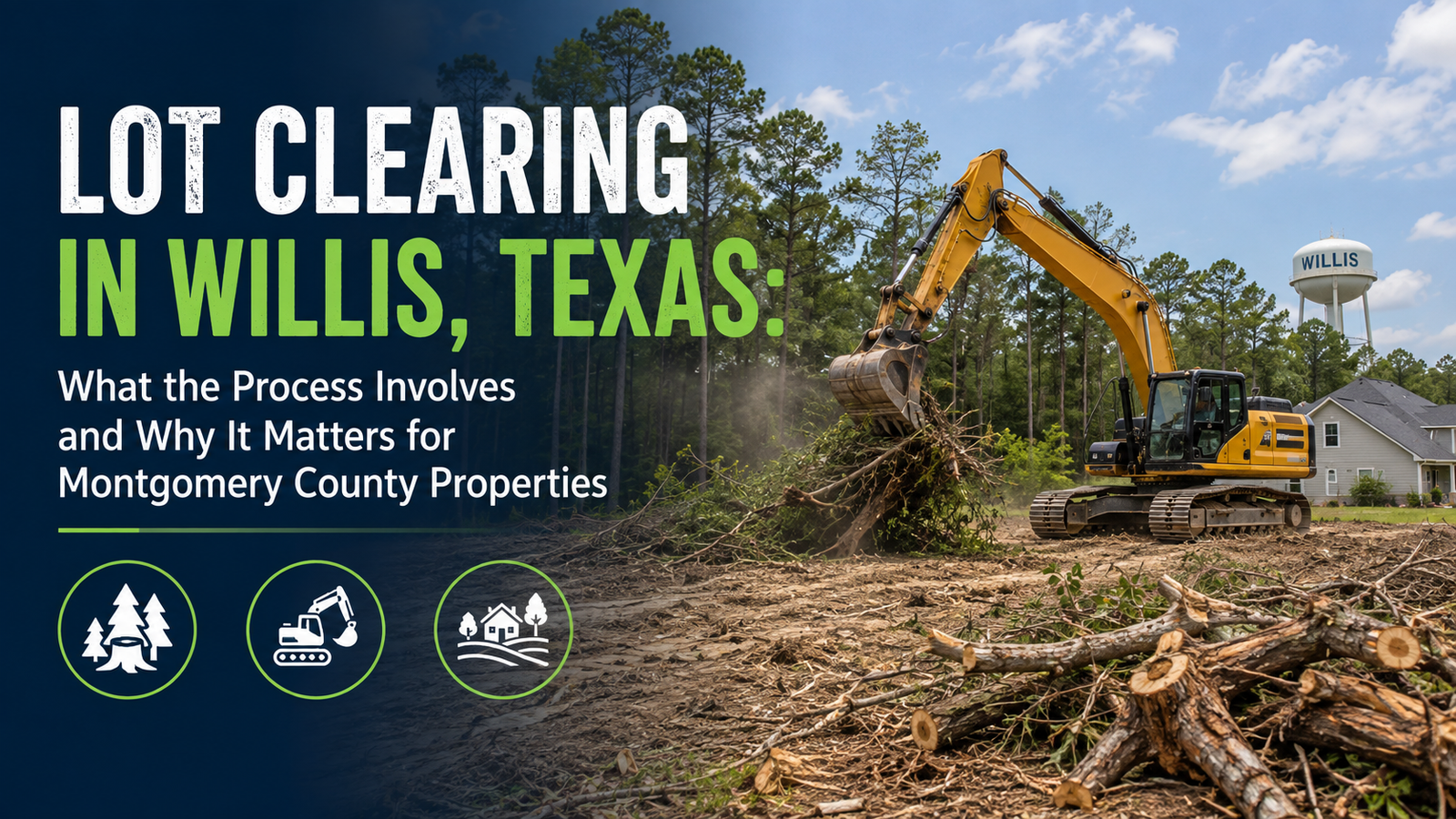
Willis, Texas sits in the northern part of Montgomery County, one of the fastest-growing counties in the United States over the past decade. Positioned along US-75 with access to Interstate 45 and bordered by Lake Conroe to the west, Willis has attracted substantial residential and commercial development as buyers seek acreage and space north of The Woodlands and the Greater Houston metro area. The result is a real estate market where wooded, brushy, and overgrown parcels are purchased constantly and where the first order of business for nearly every buyer is transforming raw East Texas land into something usable. Lot Clearing Willis is the service that makes that transformation happen, and understanding what it actually involves, what equipment is used, how it is planned, and what the specific conditions of the Willis area require gives property owners the foundation they need to approach these projects intelligently.
What Lot Clearing Actually Means
Lot clearing is the systematic removal of all vegetation, surface debris, and above-ground obstructions from a property to prepare it for a specific end use construction, landscaping, farming, recreation, or simply creating an accessible, manageable parcel from what was previously overgrown and unusable land. A cleared lot is not just a lot with no trees it is a lot that has been methodically stripped of competing vegetation to the degree necessary for the planned use, with stumps and root masses removed from critical areas, surface debris hauled or processed, and in many cases a preliminary grade established to manage drainage.
In the Willis, Texas area, lot clearing is shaped by the specific character of East Texas vegetation. Properties in Montgomery County north of The Woodlands and Lake Conroe typically contain a mix of loblolly pine (the dominant commercial timber species in Southeast Texas), hardwoods including post oak, water oak, and sweetgum, dense understory brush species such as yaupon holly an aggressive native shrub that colonizes disturbed areas relentlessly briars, native grasses, and accumulated woody debris from seasons of natural die-off and storm damage. This is not gentle English-countryside vegetation that can be managed with a lawn mower; it is dense, tangled East Texas growth that requires purpose-built equipment and experienced operators.
Lot clearing in Willis takes several different forms depending on the property’s characteristics and what the owner intends to do with the cleared land. Full clearing removes everything from the property or from the specifically designated footprint every tree, every shrub, every stump, every root mass leaving clean, gradeable ground. Selective clearing removes specific vegetation while preserving trees and other features that the owner wants to keep mature pines that provide shade and character to a future home site, hardwoods that define property lines, or native understory in areas not needed for construction. Brush-only clearing removes the understory and smaller vegetation while leaving larger trees standing, which is appropriate for pasture establishment, fence line clearing, or opening sight lines without removing the tree canopy.
The Specific Conditions of the Willis, Texas Area
Willis and the northern Montgomery County region have specific land characteristics that distinguish lot clearing work here from projects in other parts of Texas or the country. Understanding these conditions explains why experienced local contractors approach clearing projects differently than those unfamiliar with the terrain.
Soil conditions in Willis are predominantly East Texas sandy loam with areas of heavier clay, particularly in low-lying zones near drainages. The sandy loam that underlies much of the Willis upland is relatively workable but also susceptible to erosion once vegetation cover is removed. When heavy East Texas rains arrive and Montgomery County receives roughly 50 inches of annual precipitation, with events that can be intense and rapid unprotected cleared soil can be significantly eroded. This is why erosion control measures silt fencing, straw wattles, and revegetation are critical components of responsible lot clearing in this region.
The density of woody vegetation on Willis-area properties reflects the climate and the land’s history. Parcels that have been unmanaged for a decade or more develop dense yaupon thickets that can reach 15 feet in height, with lateral spread that makes conventional mowing equipment entirely impractical. Mature loblolly pines require significantly more equipment power and operator skill to fell and process than younger second-growth trees. Old stumps from previous clearing operations, buried just below the surface, can be invisible until a machine encounters them a situation that experienced Willis-area clearing contractors anticipate and account for in their equipment selection and pacing.
The East Texas wildfire context is also relevant in the Willis area. Montgomery County, Walker County, and surrounding counties have experienced significant wildfire events, particularly during drought periods. Overgrown, brushy lots with accumulated dead wood represent elevated fire risk, and lot clearing for fire risk reduction is a legitimate and increasingly common motivation for clearing work in the Willis area, independent of any construction intent.
Equipment and Methods Used in Willis Lot Clearing
Professional lot clearing in Willis employs a range of equipment matched to the vegetation density, acreage, and end-use requirements of each specific project. No single machine is universally appropriate the right equipment selection depends on a thorough assessment of what is on the property and what outcome the owner needs.
Forestry mulchers tracked or wheeled machines equipped with rotating drum heads studded with carbide-tipped cutting teeth are the primary tool for brush and small-tree clearing across much of the Willis area. The mulching head processes everything in its path into fine wood chip mulch that falls to the ground in place, eliminating the need for debris hauling in many situations. Forestry mulching is particularly well-suited to yaupon thickets, brush, and trees up to approximately 6 to 10 inches in diameter depending on the specific machine and operator. The resulting mulch layer protects the disturbed soil from erosion, decomposes naturally, and can be left in place on sites where construction is not immediately planned.
For larger trees mature pines and hardwoods beyond the effective range of a forestry mulcher chainsaw crews combined with an excavator or bulldozer are the standard approach. Trees are felled by saw, processed into logs or chunks by the chainsaw crew, and then loaded by excavator for either on-site burning (where burn permits allow in the rural Willis area) or transport to a timber yard, biomass facility, or disposal site. Loblolly pine, which is a commercial timber species with active markets in East Texas, may have salvage value depending on the tree diameter and the current timber market something worth discussing with a contractor before clearing begins.
Bulldozers typically tracked machines in the D5 to D6 range for residential lot work push cleared material into piles for burning or loading, strip the topsoil layer when required for specific applications, and perform the initial rough grading that shapes the land’s drainage patterns after clearing. For larger acreage projects or sites requiring significant earthmoving in combination with clearing, a bulldozer is typically part of the equipment mix.
Stump grinders process stumps in place, grinding them several inches below grade, which allows the cleared area to be graded and used without the disruption of stump removal. Stump grinding is appropriate for areas where stumps are isolated or where grading depth is not sufficient to remove them entirely. Where construction or grading will be performed over former stump locations, full grubbing removing the stump and root system entirely is the more appropriate approach, since grinding leaves a subsurface mass of decomposing wood that can create voids and settlement over time.
Planning a Willis Lot Clearing Project
A lot clearing project in Willis should begin with a clear understanding of the end use for the property, because the end use determines the appropriate clearing scope and depth. A property owner who intends to build a home immediately needs a different clearing outcome than one who wants to open a pasture, establish a garden, or simply make the land accessible for hunting and recreation.
For construction projects, the clearing scope should be defined by the building footprint, driveway alignment, utility routes, and setback requirements from property lines. Montgomery County and the City of Willis have specific setback requirements that govern how close structures can be to property lines, and clearing all the way to the property boundary may remove trees that have no functional benefit to remove and that represent character and shade value once the home is built. Experienced Willis-area contractors plan clearing around the planned construction opening the build pad and access, while preserving usable mature trees outside the construction zone.
Erosion control planning is a regulatory and practical necessity for lot clearing projects in the Willis area. Montgomery County’s stormwater regulations require erosion control measures on disturbed sites, and the practical reality of East Texas rainfall makes unprotected cleared soil vulnerable to rapid erosion. Silt fence installed around the clearing perimeter, especially along drainage paths and at the downhill boundaries of the property, is the minimum standard. On sites with significant slope or proximity to waterways, additional measures may be appropriate.
Texas 811 notification is required before any excavation or grubbing begins on a Willis property. The 811 call triggers location marking of registered utilities in the clearing area, preventing accidental strike of underground gas, water, or electrical lines during clearing operations. This two-business-day advance notice is a legal requirement and a practical safety measure that responsible clearing contractors manage as part of their standard pre-project process.
What Happens After the Lot Is Cleared
A cleared lot in Willis is not a finished lot it is a starting point for the next phase of the property’s development. Understanding what follows clearing helps property owners sequence their projects correctly.
For residential construction, clearing is followed by foundation excavation, utility installation, and septic system design and installation. In Willis and unincorporated Montgomery County, septic systems are required for properties not served by public sewer, and the septic designer’s site evaluation should happen before final clearing decisions are made septic drain fields require specific soil conditions, setbacks from structures and property lines, and soil types that may constrain where the system can be placed. Clearing equipment operating over planned drain field areas can compact the soil in ways that affect septic system percolation performance.
For pasture establishment, clearing is followed by soil preparation disking, ripping, or tilling the cleared ground and then seeding with appropriate forage species for the East Texas climate. Bermudagrass, bahiagrass, and coastal bermuda are common forage grasses in Montgomery County that establish well on cleared land and provide both grazing and hay production opportunity.
For properties being cleared simply to improve access and aesthetics, the cleared land may be seeded with native grass mixes or managed with periodic mowing to prevent vegetation regrowth. Without ongoing management, East Texas vegetation will reestablish rapidly yaupon and other pioneer species can return a cleared area to dense brush within two to three growing seasons without active management.
Common Questions About Lot Clearing in Willis
Does lot clearing require a permit in Willis, Texas? The City of Willis and Montgomery County have specific requirements for land disturbance and stormwater management that may require permits or notifications depending on the project size and location. Projects disturbing one acre or more typically require a TCEQ Construction General Permit with a Stormwater Pollution Prevention Plan. Smaller projects may have fewer requirements, but checking with the City of Willis and Montgomery County Engineering before beginning is always advisable.
Can pine trees cleared from a Willis property be sold for timber? Loblolly pine timber from Willis-area properties may have value depending on tree size, quality, and current market conditions. This is worth discussing with your contractor before clearing begins if the timber has value, the clearing approach and equipment selection may change to accommodate log processing rather than grinding or burning.
How long does lot clearing take for a typical Willis residential lot? A typical residential lot of one-half to one acre with mixed brush and trees in the Willis area can usually be cleared in one to two days with appropriate equipment. Larger tracts, denser vegetation, or sites requiring significant stump grubbing take proportionally longer.